Chapter · 04
Conclusion & Business Strategies
Machine learning models can effectively predict customer review outcomes and identify the operational drivers of satisfaction — and translate those into five concrete strategies for business improvement.
12 · Summary
Delivery is the lever.
This study demonstrated that machine learning models can effectively predict customer review outcomes in e‑commerce and identify the operational and product‑related factors that most strongly influence customer satisfaction. Ensemble models — particularly Random Forest and XGBoost — achieved the highest predictive performance, confirming their suitability for business‑oriented review prediction tasks.
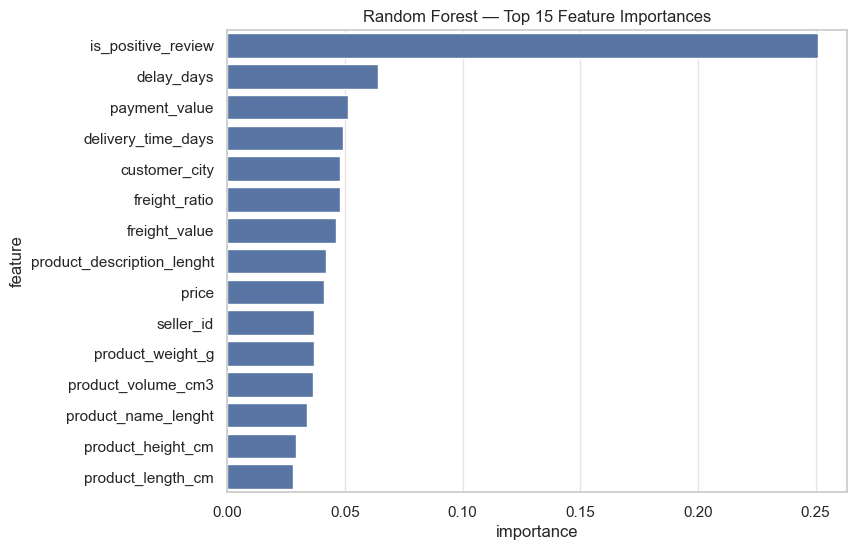
Across all analyses, delivery performance emerged as the dominant driver of customer satisfaction, with variables such as delay_days, is_late, and delivery_time_daysconsistently ranking as the most influential features. Customer review behavior — particularly leaving a comment — also played a significant role, while product attributes and payment characteristics showed moderate influence.
Key Visualization
The decisive metric.
 ZOOM
ZOOMData‑Driven Business Strategies
Five strategies, one direction: act on delivery.
01
Improve delivery reliability
Optimize courier performance and reduce operational delays. Delivery features are the dominant predictors of review outcomes across every model — making logistics the single highest‑leverage investment.
02
Enhance packaging and product handling
Treat heavy, fragile, or high‑risk items with dedicated handling protocols. Product volume and weight have measurable moderate effects on satisfaction.
03
Strengthen customer communication
Proactive delay notifications, real‑time tracking, and automated follow‑ups. Customers who comment on reviews skew strongly — turning their experience around at the right moment changes outcomes.
04
Monitor payment‑related friction points
Offer flexible installment options for higher‑value purchases. Payment behavior shows weak but measurable links to review outcomes.
05
Deploy predictive analytics for early issue detection
Use the Random Forest classifier to flag high‑risk orders in‑flight and intervene before dissatisfaction escalates — converting prediction into prevention.
11 · Limitations
What this study did not (yet) do.
These limitations primarily highlight opportunities for future research and expanded datasets — not flaws in the conclusions drawn.
§ 11.1
Class Imbalance
Far more positive than negative reviews; a structural constraint on minority‑class performance even with weighted metrics.
§ 11.1.2
Missing Behavioral Variables
Loyalty, browsing patterns, and prior purchase history were not available, limiting behavioral depth.
§ 11.1.3
Limited Use of Text Data
Review comments exist but full NLP sentiment was not applied — emotional tone underused.
§ 11.3.1
Interpretability vs. Performance
Ensemble models perform best but are less interpretable than Logistic Regression.
§ 11.3.3
No Temporal Modeling
Models treat observations independently and don't capture seasonal or operational trends.
§ 11.4
Generalizability
Findings are based on a single Brazilian e‑commerce dataset and may not transfer directly to other markets.
In Closing
Machine learning models are powerful tools for predicting customer review outcomes — and for guiding strategic improvements.
By leveraging these insights, businesses can enhance customer experience, streamline operations, and strengthen long‑term competitiveness.